
Landing Safely: Emergency Permit Procedures You Absolutely Need to Know
It is 2:00 AM over the Atlantic. You are cruising at FL370 when a warning light flickers on the EICAS. It’s an oil pressure drop in the left engine. The checklist says “land at the nearest suitable airport.” Suddenly, your scheduled arrival in London doesn’t matter. You are diverting to a country where you have no permit, no handling, and no contacts.
In moments like this, the difference between a smooth diversion and a diplomatic nightmare often comes down to one thing: how you handle the paperwork while the pressure is on.
When safety is at stake, regulations don’t disappear; they just become more urgent. Whether you are a pilot, a dispatcher, or an operator, knowing the emergency landing permit procedure isn’t just about compliance—it is about ensuring your aircraft can land, get fixed, and leave without getting impounded.
What is an emergency landing permit (and when do you need it?)
Most international flights operate on “planned permits.” You apply days or weeks in advance, get a confirmation number, and fly. An emergency landing permit is different. It is a request for permission to enter sovereign airspace and land at a specific airport on extremely short notice—often while the aircraft is already airborne.
Civil Aviation Authorities (CAAs) generally understand that safety comes first. However, “emergency” has a specific definition in this context. It usually implies an immediate threat to the safety of the aircraft or its occupants.
If you land without a permit, you are technically violating sovereignty. While international conventions (like the Chicago Convention) protect aircraft in genuine distress, the paperwork must follow immediately to regularize your presence.
Note: Requirements vary wildly. Some countries allow you to land first and file later for genuine emergencies. Others require radio contact with ATC to serve as the “permit” until you are on the ground.
Situations that commonly trigger emergency permits
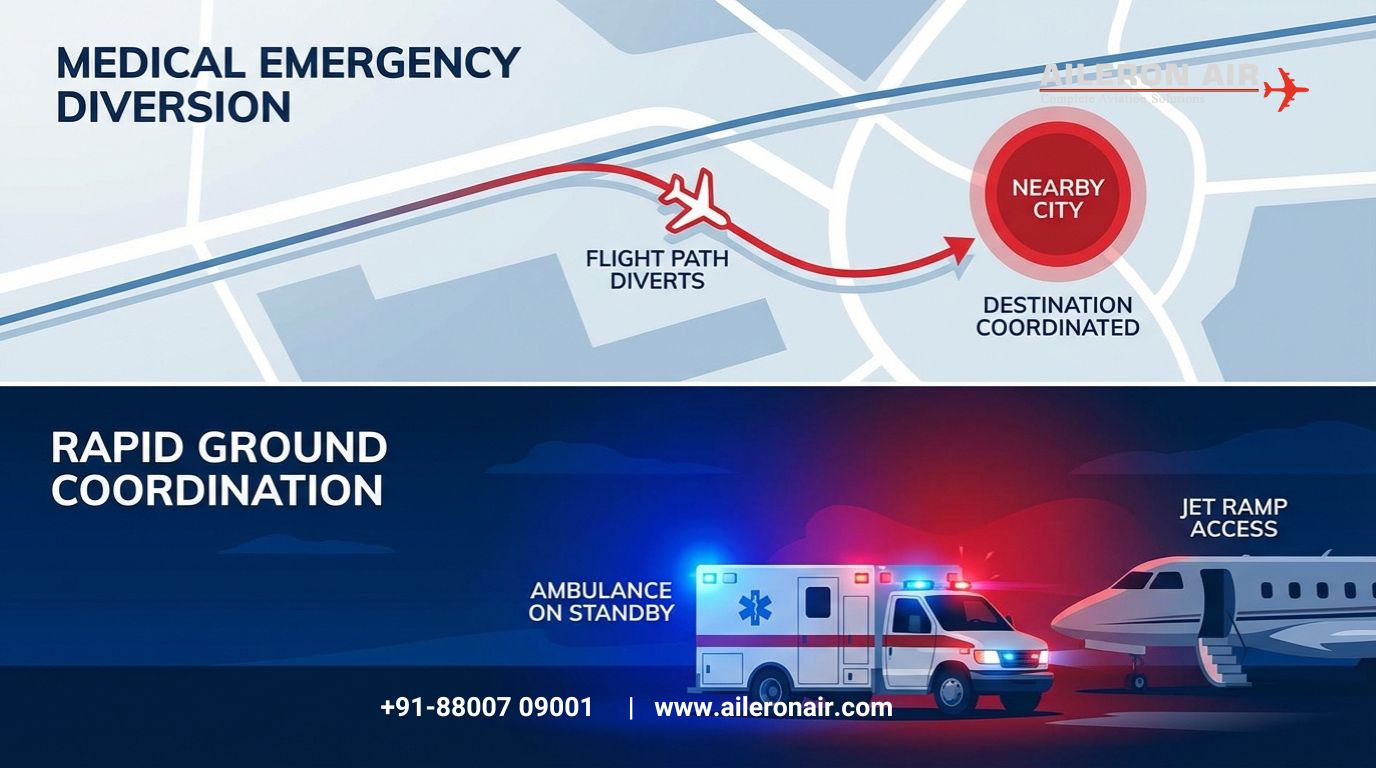
Not every diversion is a “Mayday.” However, several scenarios trigger the immediate need for emergency regulatory compliance and flight supervision:
- Medical Emergency: A passenger or crew member suffers a heart attack, stroke, or severe injury requiring immediate hospital care.
- Technical Failure: Engine issues, hydraulic leaks, or pressurization failures that force a diversion to an unscheduled airport.
- Weather: Unforecasted severe weather (thunderstorms, fog, volcanic ash) at the destination forcing a diversion to an alternate in a different country.
- Onboard Safety: Unruly passengers or security threats that require immediate law enforcement intervention.
- Crew Duty Time: Unexpected delays pushing the crew past legal flight time limits, forcing an unscheduled overnight stop.
- Airport Issues: Sudden runway closures, curfew changes, or lack of parking slots at the intended destination.
- Political Airspace Changes: Sudden closure of airspace due to conflict, forcing a re-route over countries where you hold no overflight permits.
Emergency landing permit procedure (step-by-step)

When the clock is ticking, you need a standard operating procedure (SOP). Chaos leads to mistakes, and mistakes lead to grounded aircraft. Here is a practical workflow to manage the emergency landing permit procedure.
Step 1: Stabilize the operation and confirm the diversion plan
Before you file paperwork, you need data. The Pilot in Command (PIC) makes the final decision, but the dispatch team must validate the choice.
- Is the runway long enough?
- Is the airport open (check NOTAMs)?
- Does the airport have customs/immigration (AOE status)? Once the PIC says “We are going to X,” the clock starts.
Step 2: Alert stakeholders fast
Don’t rely on a single email. You need to wake people up.
- ATC: The pilot informs ATC. This is often the first “official” record of the emergency.
- The Operator: Notify your Ops Control Center (OCC).
- The Handler: Contact a local ground handler immediately. If you don’t have one, use a global Flight Supervision & Coordination service to find one.
- Medical: If it is a medical diversion, alert ground ambulance services.
Step 3: Assemble the “permit pack”
You should never have to hunt for documents during an emergency. You need a “Go-Pack” ready. (See the checklist in the next section). Speed is vital here. If you are missing a noise certificate, it can delay your release later.
Step 4: Submit request + maintain a single communication thread
Send the permit application to the local CAA (Civil Aviation Authority).
- Subject Line: Use “URGENT // EMERGENCY LANDING // [Registration] // [Flight Number]”.
- The Method: Email is standard, but follow up with a phone call if possible.
- The Golden Rule: Keep everyone on one email chain. Don’t fracture communication. Dispatch, the handler, and the permit team should see the same updates.
Step 5: Coordinate ground handling + turnaround plan

Getting down is only half the battle. You need a plan for when you land.
- Parking: Confirm where the aircraft will park.
- Services: Order fuel, GPU, and steps immediately via your Ground Handling Service partner.
- Crew/Pax: Do they need visas? If they can’t leave the airport, arrange a lounge or airside rest area.
Step 6: Close the loop
Once the aircraft is safe:
- Ensure the CAA acknowledges the landing.
- Save all ATC logs and emails.
- Prepare for the departure permit (yes, you will need a new permit to leave).
- Conduct a post-event review to see what went right and what lagged.
Situation → What to do in first 10 minutes
| Situation | First Action (Pilot) | First Action (Dispatch/Ops) |
|---|---|---|
| Medical Emergency | Declare Pan-Pan or Mayday; Request medical at gate. | Call handler to arrange ambulance; Alert insurance provider. |
| Tech Issue | Run checklists; Select nearest suitable alternate. | Check maintenance support at alternate; Alert maintenance control. |
| Weather Diversion | Coordinate new route with ATC. | Check Permit/Slot status for alternate; secure hotel rooms. |
The permit pack checklist (what to keep ready before you ever need it)

Save this checklist and share it with your dispatch team today.
You cannot afford to scan documents when an engine is vibrating. Keep a digital folder synced to your phone and EFB (Electronic Flight Bag) containing:
- Air Operator Certificate (AOC) (or private equivalent like Part 91 letter)
- Certificate of Registration
- Certificate of Airworthiness
- Insurance Certificate (Worldwide coverage, current valid dates)
- Noise Certificate (ICAO standard)
- Radio Station License
- Pilot Licenses (Both sides)
- Pilot Medical Certificates (Current)
- Passport Copies (Crew and Pax – updated manifest)
- General Declaration (GenDec) (Draft template)
- TCAS / ACAS II Version 7.1 Compliance (Often required in Europe/Asia)
- RVSM Approval
- MNPS / NAT-HLA Approval (If crossing the Atlantic)
- FANS 1/A / CPDLC Approval
- Emergency Contact List (24/7 Ops number)
Tip: Update this folder on the 1st of every month.
Common mistakes that delay approvals (and how to prevent them)
Even in emergencies, bureaucrats love correct paperwork. Avoid these pitfalls:
- Missing “Reason” for Landing:
- Fix: Clearly state “Medical Emergency – Passenger in critical condition” or “Technical Diversion – Safety of Flight.” Vagueness causes delays.
- Expired Insurance Documents:
- Fix: Track expiry dates. An expired insurance cert is an automatic “No” in almost every country.
- Wrong CAA Contact Info:
- Fix: Use a professional team for Landing & Overflight Permits who maintain updated contact lists for every CAA globally.
- Silence After Landing:
- Fix: Don’t ghost the authorities. Update them immediately once you are on the ground.
- Incorrect Billing Information:
- Fix: State clearly who is paying for navigation and landing fees to avoid the aircraft being impounded for “debt.”
- Assuming “Emergency” Means “Visa-Free”:
- Fix: It doesn’t. Always check visa requirements for crew hotels. You might be stuck airside if you don’t.
- Sending Corrupt Files:
- Fix: Send PDFs, not blurry JPEGs. File size should be manageable (under 5MB total if possible).
- Forgetting the Departure:
- Fix: Start working on the next permit (to leave) as soon as the landing is secure.
Emergency & disruption management: how strong trip support reduces risk
An emergency landing is a high-stress event. The pilot is flying the plane; they shouldn’t be negotiating parking slots or Googling the phone number for the Benin Civil Aviation Authority.
This is where Emergency & Disruption Management services become your greatest asset.
A proactive flight support partner acts as your external control center. While you handle the aircraft, they:
- Talk to the CAA in the local language.
- Secure landing rights instantly using established relationships.
- Arrange Turnaround Management so fuel and stairs are waiting for you.
- Handle the crew’s logistics, preventing fatigue from compounding the emergency.
At Aileron Air, we provide 24/7 aviation operations support. We don’t just file papers; we manage the disruption from the initial “Mayday” call until you are safely back at your home base.
A realistic example (fictional case study)
The Scenario: A Challenger 605 is flying from Dubai to London. Over Turkey, a “HYD LOW PRESS” caution appears. The weather in Istanbul is below minimums. The captain decides to divert to a smaller airport in Bulgaria.
The Problem: The operator has no landing permit for Bulgaria, no contract fuel, and the crew has never been there. It is 3:00 AM local time.
The Timeline:
- 03:05: Captain informs ATC of the diversion.
- 03:10: Dispatch contacts Aileron Air. We immediately activate our Regulatory & Compliance Assistance protocol.
- 03:20: We contact the Sofia Area Control Centre and the local airport authority, verbally securing the emergency landing status.
- 03:45: Aircraft lands safely. A handler (alerted by us 20 minutes prior) meets the jet.
- 04:30: We submit the formal “retroactive” permit application to the Bulgarian CAA to regularize the flight.
- 05:00: Crew transport arrives. Maintenance support is dispatched from a nearby hub.
The Result: No fines, no impoundment, and the aircraft was repaired and departed 24 hours later. Without this coordination, the aircraft could have been stuck on the ramp for days awaiting clearance.
FAQs
How fast can an emergency landing permit be arranged?
In genuine safety emergencies (Mayday/Pan-Pan), permission is immediate via ATC. The formal paperwork is usually processed within 1-3 hours after landing or during the descent, depending on the country.
Who requests the permit—pilot, dispatcher, handler, or operator?
Ideally, the dispatcher or your flight support provider requests it. The pilot should focus on flying. However, the pilot must request the immediate operational diversion via ATC.
What documents are usually asked for?
Standard items include the AOC, Insurance, Certificate of Airworthiness, Pilot Licenses, and a specific reason for the diversion. (See our checklist above).
Do VIP/charter flights follow different rules?
Generally, safety rules are universal. However, VIP flights often require more discretion and specific handling for high-profile passengers, which requires tighter coordination with ground teams.
What if the aircraft diverts to a non-scheduled airport?
This is risky. You must verify runway length and PCN (pavement classification number) immediately. You may need to bring in ground support equipment (stairs, GPU) from a nearby hub if the airport is ill-equipped.
Can ground handling start before permit confirmation?
For safety services (fire, ambulance), yes. For commercial services (fueling, catering), handlers often wait for a “release” number or guarantee of payment to ensure the flight is legal.
What should crews document after the event?
Keep a timeline of all calls, save ATC recordings if possible, and keep copies of all filings. This is crucial for the post-flight safety report and any CAA inquiries.
How do you reduce risk before a trip?
Always have overflight permits for countries along your route, not just your destination. Use a Flight Supervision & Coordination service to watch your flight and react instantly to changes.
Conclusion
Aviation is unpredictable. You can’t control when a sensor fails or a passenger gets sick, but you can control the chaos that follows. Mastering the emergency landing permit procedure transforms a potential crisis into a managed event.

Don’t wait for an alarm to go off to check your paperwork. Preparation is the ultimate safety tool.
If you need support with Landing and Overflight Permits, Flight Supervision & Coordination, Emergency & Disruption Management, or Ground Handling, connect with Aileron Air. We are ready to support your mission, 24/7/365.
Disclaimer: This article is informational and does not constitute legal or regulatory advice. Aviation regulations change frequently; always consult official sources and current NOTAMs.


