
Picture this.
Your widebody aircraft is sitting at the gate. The passengers are boarded, the doors are closed, but the pushback tug isn’t moving.
The clock is ticking.
Every single minute that plane sits idle, your airline is bleeding cash.
You aren’t just losing time. You are losing passenger trust, crew hours, and straight-up profit.
In fact, a significant delay can easily wipe $50,000 or more from your bottom line on a single flight.
But what if I told you that the vast majority of these ground handling delays are entirely preventable?
In this guide, I’m going to show you exactly how the cost of aircraft delay is calculated, why your current ground operations are failing, and how implementing expert aviation turnaround management can save your airline tens of thousands of dollars per flight.
Let’s dive in.

The Silent Killer of Airline Profitability
Most airline executives severely underestimate the true cost of aircraft delay.
They look at the direct fuel costs of running the APU (Auxiliary Power Unit) and maybe some minor crew overtime.
But that is just the tip of the iceberg.
The impact of delays on airline profitability is a compounding disaster.
When your turnaround goes off the rails, you get hit with a domino effect of expenses.
Let’s break down a hypothetical 120-minute delay on an international long-haul flight. Where does that $50,000+ loss come from?
- Direct Operational Costs: Extra fuel, extended gate lease fees, and crew overtime. (Approx. $8,000)
- Passenger Compensation: EU261 or similar regional passenger rights payouts, meal vouchers, and hotel accommodations. (Approx. $20,000)
- Missed Connections: Rebooking passengers on partner airlines and lost baggage logistics. (Approx. $10,000)
- Network Disruption: The “knock-on” effect. Your aircraft is now late for its next three legs, causing a chain reaction of delays. (Approx. $12,000+)
Suddenly, a $50,000 bill doesn’t seem like an exaggeration, does it?
It’s a brutal reality.
(Want to stop the bleeding? Check out Aileron Air’s dedicated Turnaround Supervision services today.)
What Causes Massive Ground Handling Delays?
To fix the problem, you first have to understand the root cause.
Aircraft turnaround is a highly complex choreography. You have catering, fueling, cleaning, baggage, and maintenance all trying to work in the same confined space.
Without a central conductor, chaos ensues.
Here are the biggest bottlenecks draining your profits.
Baggage Handling Delays in Aviation
This is one of the most common—and frustrating—reasons planes leave late.
Baggage handling delays in aviation usually happen due to poor communication between the check-in counters, the sorting facility, and the ramp agents.
A late-arriving connecting flight means a last-minute rush of transfer bags.
If your ground handlers aren’t prepared, the cargo doors stay open, and the flight deck is kept waiting for the final weight and balance sheet.
Poor Vendor Coordination
Your caterers are waiting on the cleaners.
The fueler is blocked by the baggage tugs.
This is what happens when third-party ground handlers work in silos. They don’t care about the big picture; they only care about their specific SLA (Service Level Agreement).
When vendors don’t talk to each other, parallel processing becomes impossible.
The Infamous “Blame Game”
When a flight is delayed, what is the first thing that happens?
Everyone starts pointing fingers.
The catering company blames security. The ramp agents blame the gate agents.
This lack of accountability is the number one driver of airline operational losses due to delays. Nobody takes ownership of the overall turnaround process.
Aviation Turnaround Management: The Ultimate Fix
So, how do you stop the madness?
The answer lies in professional aviation turnaround management.
You cannot simply rely on your contracted ground handler to manage themselves. You need an independent, dedicated set of eyes on the tarmac.
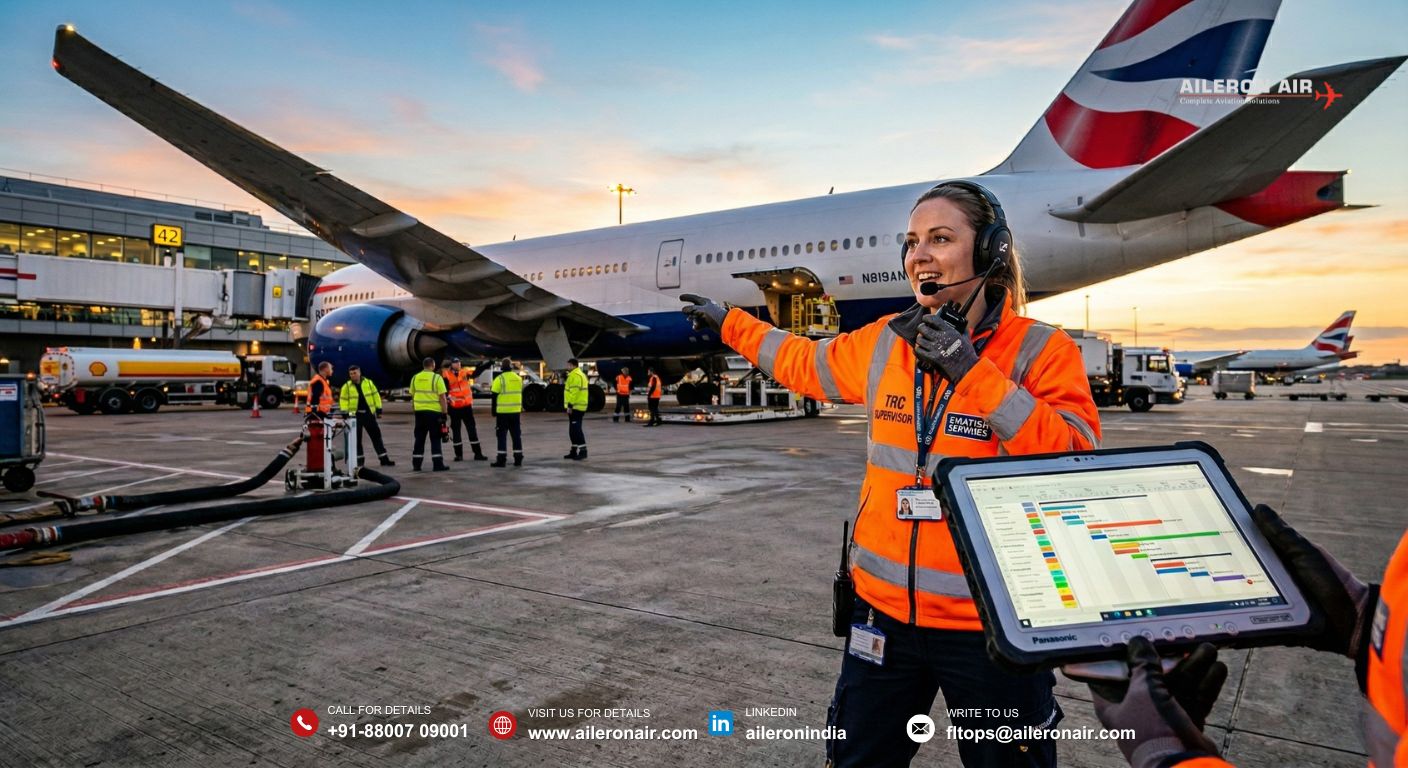
You need a Turnaround Coordinator (TRC) or Supervisor.
The Importance of Turnaround Supervision in Aviation
Think of a turnaround supervisor as the director of a live theater production.
They aren’t acting on stage, but they are ensuring every single actor hits their mark at the exact right second.
The importance of turnaround supervision in aviation cannot be overstated. A dedicated supervisor from a company like Aileron Air does three critical things:
- Anticipates Bottlenecks: They see a delay forming 20 minutes before it happens.
- Enforces SLAs: They hold third-party vendors accountable in real-time, not just in a monthly review meeting.
- Centralizes Communication: They act as the single point of contact between the flight deck, the gate, and the ramp.
Make sense?
When you have one person driving the turnaround, the entire process speeds up.
How Turnaround Supervision Saves You $50k+ Per Flight
Let’s get back to the money.
How exactly does paying for a supervisor result in a massive positive ROI?
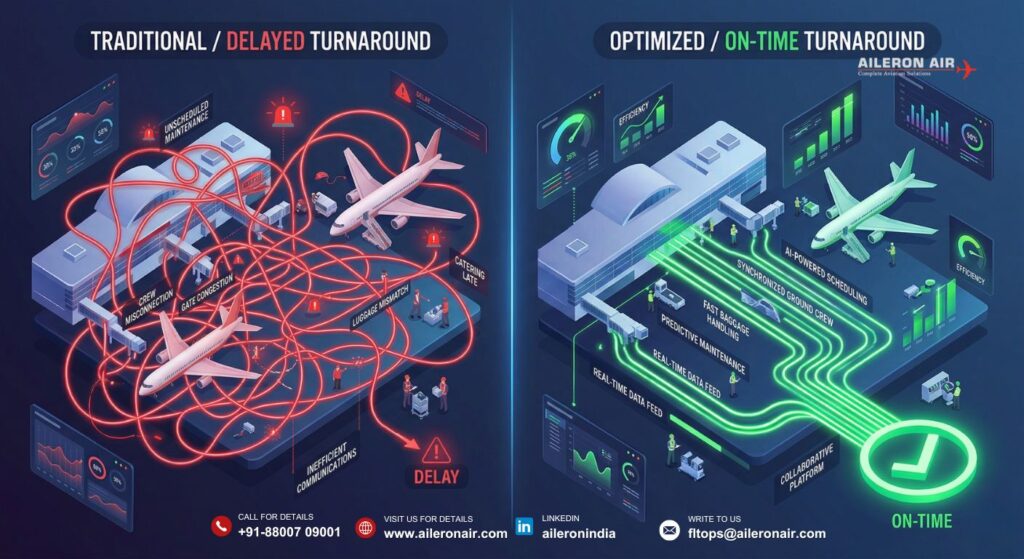
It shifts your entire operation from being reactive to being proactive.
Real-Time Problem Solving on the Tarmac
Imagine a catering truck breaks down on the way to your aircraft.
In a standard, un-supervised scenario, the ground handler might not notice until the boarding process is already halted. Panic ensues. A 45-minute delay is logged.
But with dedicated aviation turnaround management?
Your supervisor notices the caterer hasn’t arrived at the T-minus 40-minute mark.
They instantly radio the catering dispatcher, expedite a backup truck, and coordinate with the gate to slow down boarding slightly, preventing a passenger bottleneck in the jet bridge.
The delay is completely avoided.
You just saved tens of thousands of dollars in downstream costs.
Eliminating Information Silos
Information is currency on the ramp.
When your supervisor possesses real-time data about connecting bags, wheelchair passengers, and fueling status, they can make executive decisions.
They ensure the final load sheet is delivered to the captain the exact second the cargo doors are secured.
This level of precision is exactly how to reduce aircraft turnaround time consistently.
Aircraft Turnaround Time Optimization: A Mini Case Study
Let’s look at a real-world scenario of aircraft turnaround time optimization.
An international carrier was consistently facing 20-to-30-minute delays at a major foreign hub.
Their ground handlers were notoriously slow, and the airline was losing roughly $3 million annually in delay-related costs at this single station.
They brought in an independent turnaround supervision team.
What did the supervisors do?
- They audited the ground handler’s equipment and realized the baggage tractors were consistently underpowered for widebody loads.
- They established a mandatory briefing 15 minutes before the aircraft arrived at the block.
- They implemented “parallel processing,” ensuring cleaning and catering happened simultaneously through different doors.
The Result?
Within 30 days, their on-time performance (OTP) jumped by 18%.
The airline eradicated those daily 30-minute delays, effectively wiping out that $3 million annual loss.
The cost of the supervision service was just a tiny fraction of the money they saved. It was an absolute no-brainer.
3 Steps to Stop Airline Operational Losses Due to Delays
Are you ready to stop bleeding cash on the tarmac?
Here is exactly what you need to do to optimize your turnaround operations today.
Step 1: Audit Your Ground Handlers
You can’t fix what you don’t measure.
Look closely at your delay codes over the last 90 days. Are they consistently pointing to cleaning? Baggage? Fueling?
Identify your weakest links immediately.
Step 2: Implement Dedicated Turnaround Supervision
Stop relying on the ground handler’s internal supervisors. They have divided loyalties.
You need an independent supervisor whose only goal is your airline’s On-Time Performance (OTP).
By partnering with an expert team like Aileron Air, you place a dedicated “conductor” on the ramp for every single one of your flights.
Step 3: Track, Measure, and Optimize
Aircraft turnaround isn’t a “set it and forget it” task.
Use the data your supervisors gather to renegotiate SLAs with your vendors. If the catering company is consistently late, you now have the exact, unbiased timestamps to prove it.
Hold them accountable.
Conclusion: Stop Paying the Unseen Tax
The cost of aircraft delay is the highest unseen tax your airline pays.
Every minute wasted on the ground eats into your profit margins, frustrates your passengers, and exhausts your crew.
But you don’t have to accept ground handling delays as “just part of the business.”
By investing in professional aviation turnaround management and expert supervision, you can reclaim your schedule, boost your OTP, and save $50,000+ when things threaten to go wrong.
It’s time to take control of your tarmac operations.
Are you ready to optimize your aircraft turnaround times and stop leaving money on the table? [Click here to contact the experts at Aileron Air today.] Let’s build a customized turnaround supervision strategy that protects your bottom line.


